
Scripture Expands Our Options for Political Engagement
At least if we stop ignoring so much of it...

Last week, Katelyn Beaty introduced a guest post by Elizabeth Berget, a Christian author living in Minneapolis, this way:
If you’ve been paying any attention to the news the past few weeks, you’ve seen the disturbing videos and photos documenting the brutality of the ICE (Immigration Customs and Enforcement) crackdown in Minneapolis. The unlawful killing of Renee Good at the hands of an ICE agent on January 7 drew national protests over the Trump administration’s defense of Good’s death and sweeping crackdown on individuals and families without due process. World Relief, the faith-based refugee settlement agency, has condemned ICE’s actions, calling them “a five-alarm fire” and noting that families and children (such as 5-year-old Liam Conejo Ramos) are being swept up in unlawful raids.
Families are afraid to leave their homes, adults are afraid to show up at work, and children are afraid to go to school. The city is weathering ICE’s presence at the personal, social, economic, and psychological level.
And that was before Alex Pretti was horrifically killed by ICE agents. If you haven’t seen it, I’d encourage you to read the sworn testimony of a young doctor who tried to administer basic care to Pretti immediately after he was shot.
Many Christians find all this horrific, and believe Trump/ICE’s actions are wicked. Because so many others are making a powerful Christian case against Trump/ICE’s approach to immigration right now, in this post, I’m going to start from that perspective. Because even if you agree about the problem, many Christians still struggle to know how to respond.
For evangelicals like me, this struggle is compounded by the fact that many of us have been discipled into what I call a “Romans 13 Only” approach to politics.1 Our interpretation of Romans 13 (“Let everyone be subject to the governing authorities”) places severe limits on Christian resistance. We may feel like something’s gone horribly wrong, but believe that Scripture basically leaves us only one option: respectfully submit to the authorities and hope they get it right in court.
There are examples of this everywhere and throughout church history, but here’s one my friend Andrew Picard showed me from New Zealand’s history. When many New Zealanders were joining protests over apartheid in South Africa, one noted pastor preached a sermon that was then published in one of the major Christian papers. Here’s the headline.
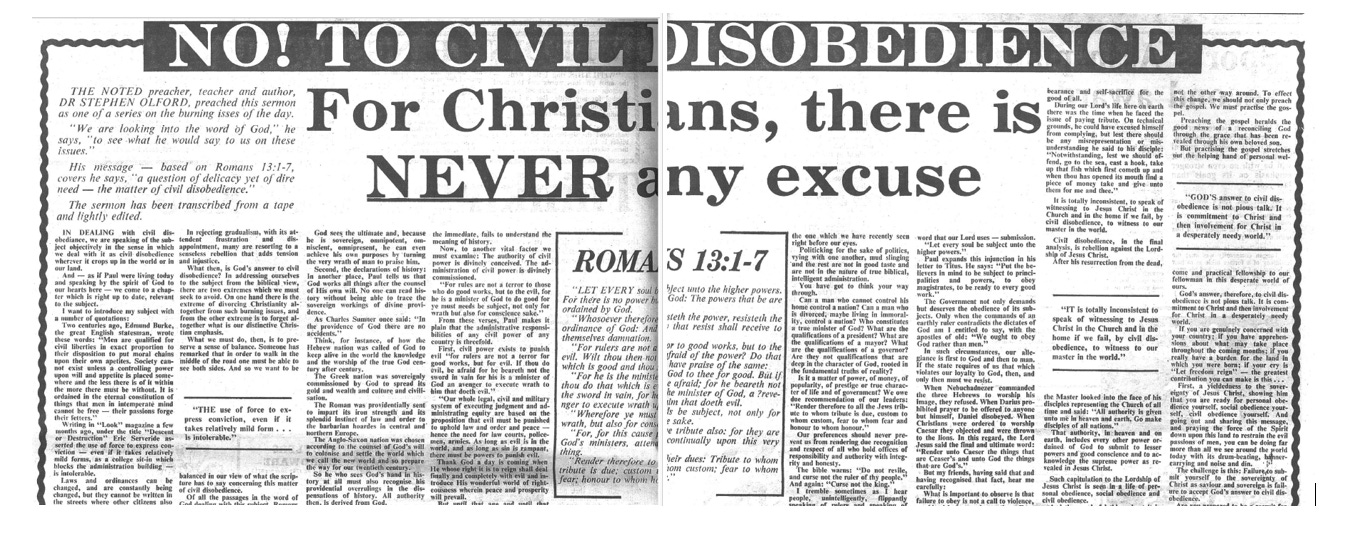
From this perspective, the Scriptural witness is clear, and places severe constraints on anything but polite prayers and quiet obedience. God said it, we believe it, that settles it.
Biblically speaking, this is nonsense. Both Paul himself and the rest of Scripture paint a far more interesting picture. In fact, as I researched my new book Reimagining Biblical Politics, I was struck again and again by the way the Bible expands our options for political engagement.
Beginning with St. Paul
While Romans 13:1-7 is often taken as obviously barring any form of disobedience to the state, Paul himself did not take this approach. In 2 Corinthians 11:32-33, he describes a time when the governor tried to arrest him, but Paul fled this legal proceeding, and managed to escape by being let down through a window in the wall of the city. Acts 14:5-7 tells of another time Paul heard of a plot to be persecuted that included local rulers, and fled to escape. At a bare minimum, these examples show that Paul did not understand his teaching in Romans 13:1-7 to require obeying the authorities in every case.
Moreover, Romans 13:1-7 is often taken to suggest that Christians need to be polite to the authorities, that our posture toward them is simply one of submission. Of course, parts of the Bible do advocate for what David Horrell calls “polite resistance,” including, perhaps most notably 1 Peter, which calls God’s people to “silence” the “ignorance of the foolish’” by freely being subject to human authorities (1 Pet 2:13-17) and even to willingly suffer for “doing good” (1 Pet 3:13ff). Likewise, the sages of Proverbs sometimes counsel that a ruler can be conquered through patience and soft words (Prov 25:15). This is an important aspect of and approach to Christian political engagement.
It’s just not the only one, even for St. Paul.
When Paul has a chance to talk to Governor Felix in Acts, he gives this ruler an apparently terrifying lecture on “justice, self-control, and the coming judgment” (Acts 24:24-25). Paul directly tells Governor Festus that the he himeslf knows Paul’s innocence yet wrongly keeps him imprisoned anyway.
In my favorite example of Paul’s more conflict-oriented political engagement, Paul directly refuses the authorities’ command to leave prison quietly and “in peace”:
“They have beaten us in public, uncondemned, men who are Roman citizens, and have thrown us into prison, and now are they going to discharge us in secret? Certainly not! Let them come and take us out themselves” (Acts 16:37).
This demand terrifies the rulers and leads them to apologize and publicly accompany Paul from prison. Paul thus stages a kind of public protest based on the flawed-yet-real legal protections he held as a Roman citizen.
Even for Paul, submission to the authorities isn’t the whole story.
Exploring Scripture’s Bigger Political Story
Beyond Paul, we see God’s people engaging the political authorities in all sorts of ways.
Jesus himself stages a public protest against the temple—both a religious and political institution—almost certainly violating some rule or other in the process (I’m guessing sending other people’s livestock running into the street or money rolling across the floor was as legally dubious then as it is now).
God rewards the Egyptian midwives after they refuse to kill Israelite boys at Pharaoh’s command, and then lie to Pharaoh about it afterward. Miriam, Moses’ mother, and Pharaoh’s daughter all likewise break the law to save Moses’ life.
When the Persian empire stops God’s people from rebuilding the temple “by force and power” (Ezra 4:23), the people eventually just ignore the king’s command and start rebuilding anyway. Interestingly, when the local authorities challenge them for quietly breaking the king’s law, they respond by quietly working the system, politely asking the king to consider allowing them to continue (see Ezra 5:1-17).
Of course, sometimes God’s people don’t quietly disobey, they loudly and publicly confront. Daniel calls Nebuchadnezzar to atone for his political sins by doing justice for the oppressed, King Lemuel’s mother calls him out for using political power for himself rather than for the poor (Prov 31), and the prophets blast the nations for their violence and injustice (check out Amos 1, for instance).
And while “Romans 13 Only” Christians often think that we must always be polite, the Bible demonstrates otherwise. Jesus derisively calls King Herod a fox (Luke 13:32-33), and Pilate a sinner (John 19:11). If the vast majority of scholars are correct that part of John’s target in Revelation is Rome—and I’m confident they are—then the book visciously lampoons the political power of John’s day. Rome may think it’s a beautiful bastion of peace and justice; John describes Rome as a vicious beast and a blood-thirsty prostitute. God’s people pray for, and will celebrate when, God brings that oppressive empire down (see Revelation 13, 17-18).
Of course, other biblical texts picture God’s people providing counsel to the authorities; Proverbs, for instance, celebrates those who “advise shalom” or “flourishing” (Prov 12:20). Daniel arguably goes further, seeking to serve God politically by working within the imperial regime. However, Proverbs reminds us that such counselors sometimes need to take a strong, public stand against evil, “rescuing those taken away to death” (Prov 24:10-12).
One way the Bible calls God’s people to stand against evil is to pray. But these aren’t always quiet, polite prayers. The psalms are filled with requests that God would break the teeth of the wicked and shatter the arm of the oppressor. Jesus himself called God’s people to plead for justice the way a widow pleaded for justice against her adversary.
And of course, much biblical teaching calls God’s people to, in the words of Jeremiah, “seek the shalom” or “flourishing” of their communities in all sorts of everyday ways, loving their neighbors in public, and “doing good to all” (Gal 6:10).
Living Into Scripture’s Larger Political Universe
Scripture doesn’t bind God’s people to any one of these particular modes of engagement at any particular moment. Shaped by Scripture, schooled by church history, and attentive to what’s going on at the street level, we must do the hard work of discerning how we will engage at this time and this place. I would argue, though, that we are called to root our diverse political actions in at least two shared commitments:
The recognition that God is the true king who demands our ultimate allegiance, and
A commitment to embrace the enemy love that characterizes his own reign and way. (Note, though, that Jesus’ and John’s practice of enemy love, for instance, doesn’t keep them from blasting the political authorities and calling on God to bring them down!).
What does that mean practically in relation to Trump’s relentless war on immigrants, waged in part through ICE’s violent abuse of power?
I think the signs are all around us.
Elizabeth Berget’s post—referenced above—outlines many of the powerful, profound ways Christians in Minnesota are seeking to love their neighbors by meeting immediate needs and offering much needed love, encouragement, and support to people living in fear because of ICE’s terror campaign. This includes those who, like Daniel, are going to work “within the system,” like the lawyers who are representing immigrants or those who have become notaries to help them get the appropriate documentation. And whether you’re there or not, you can give to organizations that care for immigrants and refugees, not least those who provide critical legal support to them.
If many of these examples echo Jeremiah’s “seek-the-shalom” or Paul’s “do good to all” approach, others opt for other possibilities. Some seek to follow in Daniel’s footsteps by serving in an elected office. Matthew Soerens and World Relief continue to do incredible advocacy work, serving as “counselors” to our political leaders on immigration and refugee issues.
And in a democracy, we act as Proverbs or Daniel-esque counselors when we call our elected officials, when we go to their offices and plead with them to change course and stop the violence, when tell them that we will not continue to vote for leaders who support such policies. We act as counselors to the authorities when we write op-eds in the local paper or sign letters like this one.
(As an aside, I hear people say all the time “oh, who can be bothered, that won’t change anything.” Not only have my friends who’ve worked for elected representatives assured me that phone calls do matter, I’m very confident that the biblical saints and most Christians throughout history and in the world today would have given a great deal to be able to pick up the phone and advise the authorities in a democratic society like ours. Ok, rant ended)
Other will strive to follow in the footsteps of Jesus in the temple or Paul refusing to leave prison without an escort and offer counsel by protest, by flooding the streets, and maybe even refusing to do what we’re told. When we see immigrant families torn apart by ICE agents, we might even be like some of Paul’s buddies and help families stay off of ICE’s radar or provide them sanctuary in our homes or churches.
If that sounds like a bridge too far, remember, God rewarded the midwives.
All of us should pray, and if your convictions are like mine, one way we may pray is to pray the “shatter the teeth of the wicked” psalms about this administration’s treatment of immigrants. We’ll pray that God will bring justice on those who dehumanize and abuse, and dismantle the structures that make it so easy for children to be ripped away from their parents, for people here legally to be roughed up and have their property damaged with no explanation by plainsclothes agents carrying enough weaponry to take over another country. We’ll pray that God will bring leaders like Trump to repentance or take them out of power.
Perhaps most difficult of all, whatever we chooose to do, we’ll seek to act out of a confidence that Jesus really is the true ruler of the world and in line with a commitment to follow him by loving even our worst enemies.2
Scripture doesn’t give us a political blueprint, and seeing the diverse ways God’s people engaged politically ought to inspire us to have some humility about the way we engage and some charity towards Christians who engage differently than we do. But right now, if you believe that Trump/ICE are doing serious evil to immigrants and citizens alike, then the Bible offers you a rich treasury of resources to imagine how to respond.
What are we waiting for?
See the discussion in Just Discipleship: Biblical Justice in an Unjust World.
I talk about the relationship between praying against enemies and praying for them, between protest psalms about injustice and the call to love our unjust enemies, in Just Discipleship.
This is excellent and articulates so well many tensions I’ve wrestled with and lessons I’ve learned over the last decade about immigration, as one who belongs to Jesus.